Monday, April 9, 2012 @ 4:00 PM
New York Law School, April 9, 2012
185 West Broadway, New York, NY 10013
2nd Floor Events Center, 4:00 – 8:00 p.m.
The Copyright Act protects “original expression,” but what is considered “original”? From Girl Talk to Richard Prince, artists are continually borrowing elements of other works to shape their own. Call it “remix,” “mashup,” “appropriation,” or “transformative”—drawing the line between infringement and fair use can be murky!
Join artists, attorneys, and academics for two panel discussions about the ways in which today’s ever-changing technologies have both facilitated the spread of creative work and sparked new debate over the current state of the Copyright Act.
Approximate Timeline:
330 – 400 Sign-In/Registration
400 – 515: Panel I
515 – 530: Break/Cookies/Coffee
530 – 645: Panel II
645 – Onward: Reception/Beer/Wine,etc
*CLE credit will be available.
Panel I: “No Copyright Infringement Intended:” Attribution and the Influence of Digital Content Exchange on Copyright Law
We see it all the time on YouTube: people communicating through shared content without permissions. Although the Copyright Act attempts to balance culture and commerce through exclusive incentive models and fair use defenses, the law just doesn’t seem to be keeping up with the way end users, developers, and content creators operate in the digital sphere. Attributing the original creator can be difficult when there is such a surplus of information on the web and when much of it is built off of preexisting works. What is original anymore? With the influx of innovative technologies comes new opportunities for artists and creators to earn a living, but it is often on the fringes of traditional copyright laws. This panel will gather artists, technologists, lawyers, and students to discuss how the law operates within these new business models, where the confusion sets in, and what needs to be done moving forward.
Panelists:
- David Carroll, Director, Design and Technology (M.F.A.) graduate program, School of Art, Media and Technology, Parsons The New School for Design
- Kirby Ferguson, writer and filmmaker (Everything Is a Remix)
- Paul Miller a.k.a. DJ Spooky, That Subliminal Kid, electronic and experimental hip hop artist
- John Brit Payne, intellectual property attorney, Foley & Lardner LLP
- Maria Popova, cultural commentator and founder, Brain Pickings
Panel II: What is the Message? Transformative Commenting and the Chilling Effects of Judges as Art Critics
Before Cariou v. Prince, most copyright infringement claims associated with appropriated works were settled out of the court. However, after Judge Batts’ ruling in favor of the plaintiff, the debate in the art community over copyright law became heated. The Copyright Act allows a fair use defense for certain transformative works; however, how do the courts decide what constitutes “transformative?” Many judges are looking to the artist to comment on their own works to validate their transformative value; however, this often runs counter to the creative methods and ideas behind the artwork. This begs several questions. What gives a work its meaning? The artist’s intention, the viewer, or the context of the work itself? How should a judge make these decisions about art? Should the “transformative” requirement be taken out of the picture entirely? Is market effect the real issue here when it comes to the art world? This panel will bring together artists, lawyers, professionals, and students to discuss the subjective nature of fair use determinations and their effects on the art community.
Panelists:
- Michelle Bogre, Associate Professor, School of Art, Media, and Technology, Parsons The New School for Design
- Daniel Brooks, Partner, Schnader Harrison Segal & Lewis LLP (attorney for plaintiff in Cariou v. Prince)
- Paddy Johnson, founding editor, Art Fag City
- David Ross, Art Practice Department Chair, School of Visual Arts
- Sergio Sarmiento, Artist and Associate Director for Volunteer Lawyers for the Arts in New York City
Please RSVP to [email protected].
]]>Let’s assume, for argument’s sake, that teaching is a unique profession, one worthy of special consideration. For convenience’s sake, I’ll call this the sui generis position. This appears to be the position of some professors’ writings in support of policies that (as discussed previously) claim copyright protection in class lecture notes to a legally questionable extent. Such support essentially argues that content created by professors and presented in classrooms should be more thoroughly protected against unauthorized use and reproduction.
Within the sui generis position, there is another position, described by Professor Ignacio Chapela in a writing reproduced at Richard Brenneman’s original post about Berkeley’s new policy:
Copyright is clearly only a subservient appendix to the commodification and privatization trends in professional training, but one that is self-defeating and absurd even in its own terms.
This quote follows a refutation of the notion that recordings or notes of the educational process are equivalent to the educational process; Professor Chapela will resist “… the commodification of my life as a teacher and researcher….” So a belief in a fundamental distinction between education and other vocations that create content can lead to two fairly divergent positions with respect to copyright protection. I think that Professor Chapela’s position is more consistent with the basic precept; the enhanced protection advocates seem to assume that market activities present a threat to their activities – in other words, the singular status of education is not something inherent (and therefore safe), but rather an imposition, an artificial separation between education and other social activities that must be maintained through policy.
One of the primary failings of a policy like Berkeley’s is that it ignores the fact that several disparate interests exist within the spectrum of work that a professor may use in teaching his or her students. As it stands, the policy assumes an adversarial relationship between student and professor – that students learn only by the leave of the professor, and that they are at all points in the educational process suspected of divulging pedagogical secrets to for-profit notes distributors.
Policies based on restrictions can, in fact, do a good and thorough job of addressing adverse effects. They are also basically useless at promoting positive effects. Permissions-based policies, in the educational realm, offer far more certainty for students as to what is allowed; they are explicitly told what they may do, as opposed to vague warnings about professors may forbid them from doing. Insofar as a primary goal of Berkeley’s policy is to prevent commercial dissemination, a professor might attach any of three Creative Commons licenses that explicitly prevent commercial use to any prepared materials distributed to students. Such a restriction still allows for the possibility of a defense grounded in fair use, even for commercial uses, but that uncertainty is certainly not lessened in a policy as restrictive as Berkeley’s. The cases that proponents of Berkeley-type policies refer to, as well as the cases I discussed in the previous installment, are by no means strong supports for such policies.
Right around the time period (the early 2000s) when legislators and academics in California were batting about the issue of increased protections for lectures, researchers at the University of Michigan were thinking about the problem of low-quality notetaking by students. Collaborative review, reorganization, and rephrasing of concepts are some of the tools suggested by the UMich paper – such activites, in a balancing act between professors’ and students’ rights (or, phrased differently – between professors’ rights and professors’ responsibilities), should be encouraged by school policies. This cannot be properly accomplished by merely emphasizing professorial copyright; that, as Berkeley’s attempt shows, ends up distorting the teacher-student interaction into the very model of the market-style contractual exchange the sui generis position denounces. Permissive policies would be as effective in getting students to take note of the fact that rights may inhere in educational presentations (more so, if you want them to understand what those rights actually are), and would also emphasize, as a matter of policy, the fundamentals of good note-taking.
As an ideological issue, it is troubling that educators would support a policy blatantly ignoring fair use, when fair use has been invoked (successfully or not) in quite a few instances where educators are the accused infringers. As a policy matter, it would provide normative and legal consistency if universities would ensure that the stances adopted at both ends of the spectrum – as accused infringers and as aggrieved rightsholders – were at least compatible, if not identical.
In the next and final post on the subject, I’ll delve into the specific characteristics of a permissions-based policy, examining what language and terms such a policy might incorporate, and how its provisions provide the same substantive protections, while providing a better balance of rights than, restrictions-based policies.
]]>TechDirt’s article discusses who actually invented email, and why Mr. Ayyadurai’s claim is false. This post focuses on how the dispute illustrates how intellectual property law can throw a wrench in the way people outside of the legal system come to conclusions about issues of creation, authorship, and invention. Responding to comments about its article, the Washington Post issued a “clarification” reading thus:
A number of readers have accurately pointed out that electronic messaging predates V. A. Shiva Ayyadurai’s work in 1978. However, Ayyadurai holds the copyright to the computer program called“email,” establishing him as the creator of the “computer program for [an] electronic mail system” with that name, according to the U.S. Copyright Office.
This is akin to saying “hamburgers predate Ronald McDonald’s work, however, McDonald holds the copyright to a clowning routine, involving the production of hamburgers, called “hamburger,” establishing him as the creator of a ‘clowning routine for placing beef patties between pieces of bread’ with that name.” More than that – it would seem that, at the Washington Post, this reasoning would support a claim that McDonald invented hamburgers.
The TechDirt article notes that the non-clarifying clarification appears to conflate copyrights with patents. The Washington Post, in that case, would be confusing invention with authorship, which is somewhat alarming, coming from a newspaper.
The Post’s description of Mr. Ayyadurai’s stance on intellectual property issues is similarly disheveled. Mr. Ayyadurai says, “I fundamentally do not believe in the patenting of software. It would be like Shakespeare patenting the tragic love story.” He “prefers copyright, which allows others to innovate using the technology.” The first position is relatively uncontroversial, even though it ignores the fact that Shakespeare never could patent the tragic love story, at least not in the United States, and that American courts have, in theory, never embraced software patents that embody nothing more than abstract ideas without concrete application.
The second position, his preference for copyright, is more problematic, because copyright does not protect, or even address, technological innovations. Any usefulness, or utility, described by a copyrighted work must be patented in order to be protected .What copyright protects is individual, singular expression. In other words, it prevents others from appropriating the language an author uses to express a concept or idea. Shakespeare could stop others from copying Romeo’s monologue at Juliet’s balcony, not the idea that a hormonal teenage boy mght do romantic but embarrassing things to woo a girl. Similarly, copyright in software prevents copying, not the use of any innovations described.
The Post also comments that, “by pursuing a copyright on his email work, Ayyadurai opened it up for use, but with credit.” Copyrights are not pursued as patents are; all works of authorship are protected by copyright, whether or not the author registers his work with the Copyright Office, or even places notice of copyright on his work (the © symbol, for instance). Registration is really just a way to ensure that the author is able to sue for money damages should infringement occur. Also, a right to attribution (crediting the author) is not inherent in American copyright law, except in certain cases involving visual artists.
When legal concepts seep into social discourse – here, by underpinning the Post’s assertion that Mr. Ayyadurai invented e-mail, they interact with and modify non-legal concepts. In this case, to have invented something is equated with getting a copyright. This is wrong, as a matter both of law and of plain language. It points to a failure of intellectual property law as a mediating force between creators and the public at large – if no one, not even knowledgeable groups like the Washington Post, really understands what patents, copyrights, and trademarks are, or if misapprehensions such as those illustrated above become common, then how can IP law really incentivize creation and disincentivize misappropriation? It can’t – it simply breeds costly and inefficient litigation that settles specific cases, without clarifying the law for other parties. Shouldn’t laws that encourage technology, literature, and progress in general do better than that?
]]>Ireland’s version of SOPA is not the equivalent of a Congressional bill; instead, it is a statutory instrument(SI), a piece of secondary legislation “made in exercise of a power conferred by statute.” What this means is that the legislation will not be considered by the Oireachtas, the legislature of Ireland, before passing into law. Instead, an emergency debate on the SI has been heard in the Dáil, the lower house of the Oireachtas.
A brief history of “Ireland’s SOPA:” In EMI Records v. UPC Communications, the High Court of Ireland determined that “Ireland is not yet fully in compliance with its obligations under European law.” As per the court’s analysis, European law requires the provision of injunctive remedies against internet service providers who facilitate copyright infringement, and such remedies are absent in Irish law. The proposed statutory instrument is being shepherded by Sean Sherlock, Minister for Research and Innovation of the Department of Jobs, Enterprise and Innovation. The SI would amend the Copyright Act of 2000, giving the judiciary broad powers to grant injunctions against “intermediaries,” such as ISPs, forcing the blocking of target websites.
The Internet Service Providers Association of Ireland has issued a letter objecting to the SI, and TJ McIntyre has posted a FAQ describing what is known about the text of the new instrument (not much, but he includes language from a previous draft) and what the implications of its passage may be. In a nutshell, Ireland’s SOPA may allow courts, when petitioned by copyright owners, to order ISPs and other “intermediaries” to block access to infringing content. He has also commented on the inadequacy of an emergency debate as a substitute for true deliberation.
In some ways this proposed SI is more insidious than SOPA – the provisions of SOPA allowed opposing groups to understand, to a point, how the legislation worked, and what it might allow copyright owners to demand. This SI does not define what the judiciary may order in any injunction, nor does it say what may not be ordered. Uncertainty and a lack of transparency is a large part of the argument against the SI.
During the debate, a number of deputies voiced the concerns noted by Mr. McIntyre and others – notably, the vague language of the SI, as well as potential negative effects on smaller ISPs and sites that post user-generated content. One of the centerpieces of Minister Sherlock’s defense was the idea that the SI “clarifies” preexisting policy – that the EMI v. UPC ruling: (1) exposes Ireland to legal action for alleged non-compliance with European law, and (2) the SI simply closes the hole exposed by the High Court ruling, rather than creating a new remedy for copyright owners. He also emphasized that there are no plans to change the wording of the SI, and that there are no plans to delay its enactment.
Despite the real – and significant – differences between the proposed SI and SOPA, they both seek an expansion of governmental power to control what is available on the Internet, and they both do so in a manner that leads to legitimate objections including: overly broad remedies for copyright owners at the expense of the public interest; the imposition of burdensome costs on ISPs and other intermediaries; and a chilling effect on Web-based innovation, creativity, and business founded in legal uncertainties.
More information about a petition to stop “Ireland’s SOPA” here.
]]>
(Image by Mike Linksvayer)
The policy states that “[i]ndividual instructors retain copyrights to lectures and class presentations, class materials they create, and related material pursuant to U.S. copyright law, California Civil Code § 980 (a)(1), and the University of California’s Policy on Copyright Ownership.” This language invokes three separate wellsprings of authority – federal, state, and institutional. A brief look at each in turn:
Section 102 of the federal Copyright Act informs us that copyright protect subsists, in general, “in original works of authorship fixed in any tangible medium of expression . . . .” The key term for our purposes is “fixed,” which pushes many, if not most, typical classroom lectures out from under the copyright umbrella. Extemporaneous presentations, unless recorded in some manner, do not get copyright protection.
California Civil Code §980 does grant ownership rights on unfixed presentations: “[t]he author of any original work of authorship that is not fixed in any tangible medium of expression has an exclusive ownership in the representation or expression thereof . . . .” Although the federal Copyright Act, in section 301, explicitly preempts state laws that provide similar rights, §980 avoids such preemption by dealing with works explicitly unprotected by federal copyright. It does look like a good foundation for the Berkeley policy, but the U.S. District Court for the Central District of California has found that §980 reflects a legislative intent “to deny copyright protection to ideas, as opposed to the manner in which they are expressed or represented.” (See page 1423 of the opinion) This preserves the core idea-expression dichotomy that prevents copyright law from protecting ideas and facts, rather than a specific expression of them. In essence, we can say that §980 effectively extends federal copyright-type protection, within the state of California, to unfixed works of authorship, but with limitations on subject matter analogous to those created by §102 of the Copyright Act.
Finally, the University of California’s copyright policy is more a policy statement than a grant of unique institutional rights. It states, in part: “The University encourages the creation of original works of authorship and the free expression and exchange of ideas.” Reasonable minds may disagree on whether copyright protection promotes or stifles the creation of original works, but Berkeley’s policy is an incontrovertible shackle upon students’ ability to engage in any exchange of ideas based upon those works.
How might a judge apply these laws? Faulkner Press v. Class Notes, a federal case in the Northern District of Florida, in which the defendant (a notes reseller) sold note packages including a significant amount of material copyrighted by Professor Michael Moulton. This material was prepared and recorded beforehand, and properly the subject of federal copyright protection. Judge Mickle informs us that fair use is a potential stumbling block for the sort of broad prohibitions embodied by Berkeley’s policy:
Even though the film study questions and practice questions are protected by copyright, genuine issues of fact remain as to whether inclusion of the questions, as well as the lecture summaries, within Class Notes’ note packages constitutes fair use…. Dr. Moulton’s works as a whole are derivative, factual, and published. Furthermore, his film study questions and practice questions are factual compilations. Copyright protection extends only to the selection and arrangement, not to the underlying facts themselves, and “[t]his inevitably means that the copyright in a factual compilation is thin.” Feist. 499 U.S. at 349. So in determining fair use, this factor will weigh against Faulkner Press.
With respect to California state law, some proponents of expanded professorial control over academic presentations find support in the ruling of the California Supreme Court in Williams v. Weisser, a 1969 case in which the court ruled in favor of a plaintiff professor against a note reseller defendant. Two points tend to weaken that support: first, the case predates the Copyright Act of 1976, which expressly preempts state laws that grant analogous rights and remedies. Second, the Court in Williams did not rely upon the protection of unfixed works granted by §980:
This is, therefore, not a case where the concrete expression of the “composition” (Civ. Code, § 980, subd. (a)) consists solely of an intangible oral presentation. (Nimmer on Copyright § 11.1.) As far as this litigation is concerned, the chief importance of the oral presentation is that it provided defendant with access to plaintiff’s work and with an argument that there had been a divestive publication.
Taken together, these two points mean that the common-law copyright jurisprudence applied in this case, in favor of the plaintiff, would today be preempted by federal statute.
A good look at the statutes and their application by judges should be enough to demonstrate that, if they try to exercise the “rights” granted by the Berkeley policy in a court of law, professors shouldn’t rely on an easy victory.
In the next installment: a discussion of the public policy issues that underlie the Berkeley notes policy, and how a licensing-and-permissions-based policy is more in line with the interests of educators and students than a rights-and-restrictions-based one. Also – to what extent do students and professors actually care what school policies say, and how should that inform the content of such policies?
]]>
Late last year, UC Berkeley implemented a new policy regarding the taking and using of course notes and other class materials. It “sets forth the limitations on use of course notes and course materials and the making and use of recordings of instructors’ class presentations,” and proceeds to describe a rather draconian regime in which students’ use of their notes and class materials – indeed, their right to take notes at all – may be severely curtailed by their professors. Berkeley’s Office of Educational Development has also posted a set of cease and desist letters that professors may use, against students or third parties.
This is the first in a series of posts addressing Berkeley’s new class notes policy – in this introductory post, I will outline the issues involved and point to places where Berkeley’s policy conflicts with federal copyright law. Future posts will include a more detailed analysis of what rights copyright law provides compared to the rights Berkeley’s policy purports to take, as well as the benefits of a permission-based access and dissemination policy over a restriction-based one (essentially, telling people what they can do rather than what they can’t); I will also discuss the validity of the concerns the new policy seeks to address – specifically the professorial interest in repressing his work versus the social interest in open access; and finally, examine what terms a genuinely useful note-taking policy might include, one based on access rather than restriction.
This new policy is an unfortunately ironic development at UC Berkeley, the site of the 2008 Students for Free Culture conference. It was at this conference that the Wheeler Declaration was drafted, which included “open educational materials” as one of the five criteria of a truly “open” university. Needless to say, Berkeley’s new restrictions on the dissemination of such materials represent a step away from the open university movement. Given that all aspects of the University of California’s mission statement – to teach, research, and serve the public – are arguably better served by more distribution of knowledge, rather than less, there seems to be an internal dissonance here as well.
Berkeley and other UC faculty have, naturally, commented on the new policy. Richard Brenneman has an excellent post detailing some of their reactions. He includes e-mails objecting to the policy from Professors Amy Kapczynski and Ignacio Chapela, both at UC Berkeley, as well as comments supportive of the new policy from Professor Robert Meister, President of the Council of UC Faculty Associations. All following quotations from these professors are derived from Mr. Brenneman’s post.
In support of the policy, Professor Meister writes that “This seems to be a belated (and welcome) implementation of AB 1773, which was CUCFA’s response to UC’s (and especially UCLA’s) attempt to exploit a gap in copyright law to claim the right to record and re-use class presentations, such as lectures, and to get adjuncts to expressly agree to this as a condition of employment.” AB 1773 is a California state law, passed in 2000, that amended the California Education Code, adding sections 66450 – 66452. Section 66450 reads as follows:
66450. (a) Except as authorized by policies developed in accordance with subdivision (a) of Section 66452, no business, agency, or person, including, but not necessarily limited to, an enrolled student, shall prepare, cause to be prepared, give, sell, transfer, or otherwise distribute or publish, for any commercial purpose, any contemporaneous recording of an academic presentation in a classroom or equivalent site of instruction by an instructor of record. This prohibition applies to a recording made in any medium, including, but not necessarily limited to, handwritten or typewritten class notes.
(b) Nothing in this section shall be construed to interfere with the rights of disabled students under law.
(c) As used in this section:
(1) “Academic presentation” means any lecture, speech, performance, exhibit, or other form of academic or aesthetic presentation, made by an instructor of record as part of an authorized course of instruction that is not fixed in a tangible medium of expression.
(2) “Commercial purpose” means any purpose that has financial or economic gain as an objective.
(3) “Instructor of record” means any teacher or staff member employed to teach courses and authorize credit for the successful completion of courses.
Professor Meister’s comments highlight some of the ideological motivations behind the Berkeley policy, which, in his view, has roots in a long-standing conflict of interest between instructors and administrators over who has control over materials created by professors in the employ of the University of California. Professor Meister ends his e-mail with a normative claim, that professorial – rather than institutional – ability to “set the terms on everything beyond note-taking” is a distinction between academics and other varieties of institutional employees that “lies at the heart of academic freedom.” But the language of the California Education Code requires that any claim to such a distinction must rest upon sound legal ground – Section 66452(a) stipulates that “[n]othing in this chapter is intended to change existing law as it pertains to the ownership of academic presentations.” §66450(c)(1) identifies academic presentations as being unfixed – precisely the sort of thing that, as Professor Kapczynski notes, federal copyright law does not protect.
Distilled, the problem Berkeley’s new policy seeks to address seems to run thus: Third parties, gaining access to class notes and materials, have been selling those materials to students and others for a profit. This has already been the subject of litigation, as in Faulkner Press, L.L.C. v. Class Notes, L.L.C., Case. No. 1:08cv49-SPM/GRJ (N.D. Fla., 2010). Disregarding, for the time being, the obvious pecuniary motivations faculty and administrators may have in curtailing such activity, there are normative considerations that are worth discussing – a professor’s right (or lack thereof) to privacy in the comments he makes to a closed classroom, for example, which will be discussed in a later post. Broadly stated, this policy, in attempting to protect the interests of some faculty members against note-selling groups, is most detrimental to students and anyone else interested in open education and technology as a route thereto.
Professor Kapczynski writes that “it’s not obvious that copyright policy offers the best (or an adequate) response to the challenges of peer-to-peer networks for our modes of teaching.” Berkeley’s policy, which responds to these challenges by asserting rights beyond those that federal copyright law actually bestows, and ignoring the availability of fair use defenses where valid rights exist, is almost certainly not the best means by which to balance the interests of institutions, faculty, students, and the public. In the next post on this topic I’ll be examining, in more detail, the interests of all parties affected, relevant copyright law and precedent, and how Berkeley’s policy interacts with both federal law and other UC policies.
]]>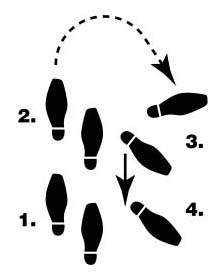 A brief opinion on the Mackie/Hipple settlement, by a law student standing on the shoulders of giants.
The facts, as best I know, go something like this: about 32 years ago, Seattle artist Jack Mackie used public funds to create the “Dance Steps on Broadway” sculptures. These bronze footsteps in the concrete taught pedestrians how to do dances like the Rhumba and Foxtrot on the sidewalks lining Broadway in Seattle’s Capitol Hill. Mackie showed his litigious side in 1996 when he stopped the Seattle Symphony Orchestra from using an image of his sculpture in a promotional mailer. ) In 1997, Seattle photographer Mike Hipple took a photograph of someone’s feet on Mackie’s sculpture and put it on a stock photograph website for sale. Mackie sent a cease and desist, which Hipple complied with and subsequently destroyed all copies of the contentious photo. However, this action was not enough for Mackie because last year he decided to sue Hipple for copyright infringement over the photograph. http://www.techdirt.com/blog.php?tag=mike+hipple&edition=techdirt Hipple decided to settle rather than fork over the time and money necessary to defend a claim of copyright infringement.
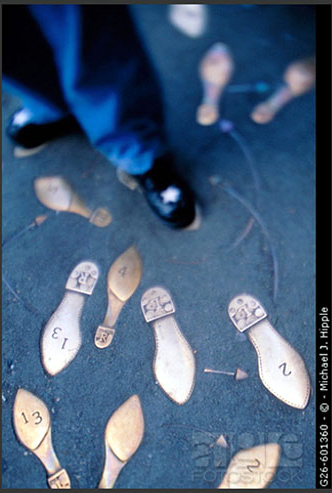 It was unfortunate that Hipple felt compelled to settle. (http://capitolhillseattle.com/2011/06/29/broadway-dance-steps-lawsuit-settled-not-worth-continuing-to-fight)However, it is understandable as Hipple would have been at the mercy of the courts, and thus faced a chance of being sued for the statutory damages. Under the copyright statute 17 USC § 504,(http://www.law.cornell.edu/uscode/uscode17/usc_sec_17_00000504—-000-.html) statutory damages for copyright infringement can range anywhere from $750 to $150,000. I am not aware of Hipple’s personal financial situation, but the chance of having to owe $150,000 is a hard pill to swallow for any artist. (http://hipple-ldf.blogspot.com/2011/06/settlement_29.html)
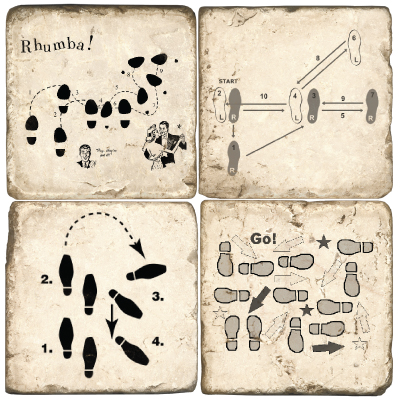
The unfortunate part is that Hipple stood a fairly strong chance to gain some revolutionary ground in copyright law. Had this claim escalated to litigation, a holding that Hipple’s photograph was transformative would have been groundbreaking. To have the statutory damages cause an artist to shy away from defending the progression of his art directly infringes on the main constitutional policy of copyright law to “promote the progress of …useful arts.” US Constitution, Article I, §8.
In his dissent written for Sony Corp of America v. Universal City Studios, Justice Blackmun stated that “the goal of copyright, is generally furthered by the creation of transformative works.” Hipple’s photograph has transformed Mackie’s sculpture in such a way that does not infringe on the sculpture’s copyright. Hipple’s photograph is a prime example of fair use:
The first factor of fair use requires analysis of the purpose and character of the use. Hipple had placed his photograph on a commercial, stock photograph website, the purpose of his use would be considered commercial by the courts. This factor would weigh in favor of Mackie; however, In Folsom v. Marsh, Justice Story stated that the character of the use should consider the transformation of the art. If one considers the transformative character in the first factor then this factor should actually weigh in favor of Hipple. Hipple’s photograph takes the original sculpture, puts feet on it to show its functional use, and photographs it; thus remixing and totally transforming the sculpture. Hipple’s remix of the sculpture creates a whole new expression in the photograph and that new expression should be protected. In a culture that builds off of itself, where no art is truly original, it is important for artists (like Mackie) to recognize and appreciate when other artists uses their art in a transformative way. If anyone should appreciate the transformative aspect of art building on itself it should be Mackie, as I am certain he was not the artist who created the Foxtrot or the Rhumba. Furthermore, the practice of drawing tutorial footsteps originated in dance studios long before Mackie took the idea to the streets.
When looking at the second factor of fair use, the nature of the copyrighted work, courts evaluate the value of the materials used and how close that value is to the core of intended copyright protection. The closer the work is to the core values, the more difficult it is to establish fair use. The intent of copyright protection is to foster creative and original creation. Mackie’s Dance Steps are not exactly novel, as mentioned previously, Mackie’s sculpture is remixed art. Thus why does his reworking of previous art deserve stifling protection to hinder another artist from doing the same thing?
Further, the court in Campell v Acuff Rose states that the second factor is of less (or even no) importance when assessed in the context of certain transformative uses. Hipple’s photograph is merely taking Mackie’s transformative sculpture, of tutorial dance steps, a step further; thus any “creativity” Mackie had in placing the Dance Steps in concrete should be irrelevant in a fair use analysis. Like the parody protected in Campell, it was necessary for Hipple’s photograph to use Mackie’s sculpture; the feet needed the Dance Steps. By placing the feet in the photograph with the Dance Steps, Hipple transformed a three dimensional sculpture into a two dimensional photograph catching a pair of feet putting the sculpture to the functional use of original dance tutorials. Hipple’s photograph essentially catches the dance steps serving a practical purpose, to teach pedestrians how to do the dances sculpted. Due to this practical use, the Dance Steps on Broadway should receive a very low level of copyright protection, in any. Hipple’s photograph can also be compared to a criticism of Mackie’s sculpture, alluding to its natural predecessor.
The third factor of fair use requires the court to analyze the amount and substantiality of the portion of the copyrighted work taken and whether that amount was reasonable in relation to the purpose of the copying. Mackie filed one registration for the several Dance Steps on Broadway sculptures with the United State Copyright Office. (http://cocatalog.loc.gov/cgi-bin/Pwebrecon.cgi?v1=2&ti=1,2&SC=Author&SA=Mackie%2C%20Jack%2C%201946%2D&PID=DrhimXv0qR34QHdIdM7aY3B6hGFO&SEQ=20110801120756&SID=3) (What I believe to be) the infringing photograph uses merely a blurred out portion of one of these sculptures.(http://seattlest.com/2011/07/09/a_quiet_seattle_lawsuit_settlement.php
*All images were added under fair use. This is a noncomercial, educational post.
]]>This week the the creator, ginnyisaprincess, came out with a sequel We R Slytherins (Ke$ha parody)
, but unlike the ravenclaw video you may not see the video because Sony does not understand viral marketing or fair use.
When I embed the video and try to play it in Google Reader it I get this message:
“This Video contains content from a Sony ATV Publishing. It is restricted from playback on certain sites. Watch it on youtube”
Sony… what are you thinking?
viral = good
restricted payback /= viral
Okay Go left EMI over this!
By putting restriction on a video like this your are making it tougher for people to give you free press.
Beyond that the video remix/parody here is likely fair use and the restriction equals more then just bad policy it equals censorship.
Thanks Game Girl ESQ for sharing these videos!
]]>For the cover of the album he had someone remix the original cover art to turn it into an 8 bit version.
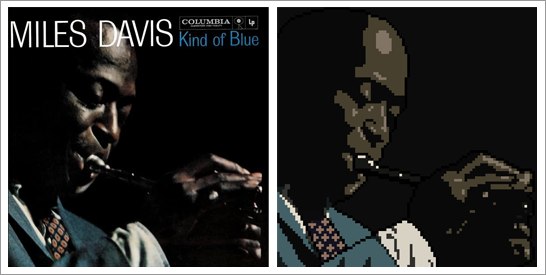
The original cover art was based on a photo Jay Maisel. For remixing Jay Maisel’s photo, Andy was hit with a copyright suit asking for $150,00 per infringement plus legal fees. To put this in context the project only cost 2k to license all the music involved and to create the tribute. Andy also explicitly stated that the whole project was being done for fun and that he was not keeping the proceeds:
To create this album, I hope to raise $2,000 to pay royalties, pay the artists, and print CDs. Legally releasing cover songs requires paying mechanical licenses to the song publishers through the Harry Fox Agency, totaling about $420 for every 250 downloads and a $75 processing fee. I’ll be using the remainder to print a very limited run of CDs for Kickstarter backers, and split the rest evenly among the five musicians for their painstaking work. (This is a labor of love for me, so I won’t be keeping a dime.)
This was basically a noncommercial venture made at cost.
When you look at the legal threat asking for 75x the cost of production it is clear that the legal threats were not about a fair license agreement, but about controlling art. When faced with these legal threats Andy decided settled out of court for $32,500 and Andy is “unable to use the artwork again” as part of the settlement. Read that again, this is not a 32k license agreement. This is a 32k penalty, that comes with a censorship agreement. The settlement is 4x the total that was brought in by the kick starter to fund the whole project and is extremely troubling for three reasons:
- The remixed cover art is likely a transformative fair use and should not have to be licensed - Andy does a good job of making the transformative point in is post, and pointing out that fair use.
- Licensing an image for remix is very difficult as there is no compulsory license mechanism. Fred Beneneson makes this point well in -There’s No Such Thing as a Compulsory License for a Photo
- Copyright is being used here as censorship not at a way to encourage new works to be created. This is where I am joining the discussion.
The most disturbing part of Andy’s post was the reaction to the 8 bit art work cover by the photographer:
And it’s worth noting that trying to license the image would have been moot. When asked how much he would’ve charged for a license, Maisel told his lawyer that he would never have granted a license for the pixel art. “He is a purist when it comes to his photography,” his lawyer wrote. “With this in mind, I am certain you can understand that he felt violated to find his image of Miles Davis, one of his most well-known and highly-regarded images, had been pixellated, without his permission, and used in a number of forms including on several websites accessible around the world.” (emphasis added)
Remix art work that is disturbing to the original artist is just the type of art work that needs to be protected by fair use! Fair use is the codification of the free speech in the copyright act. Disturbing transformative art work that targets the original work has a stronger fair use claim if it is criticizing the original work, ie parody. Now this is not a typical case of parody as the remixer here likes the original work, but it bares several similar aspects with regard to how the artist reacts and the art5ist unwillingness to license at any price.
When one can not license to create art work we must have an exception or copyright becomes a blunt instrument of censorship.
This is the third another example of a remix case that has gone horribly wrong for remix artists.
- AP v. Shepard Fairey for basing his famous Obama Hope poster on a news photo. (Fairey faked evidence harmed the fair use claim)
- JK Rowling v. RDR – Lexicon ruled not fair use, never appealed
One Thing to learn from all of these cases though is that the law fails to kill remix culture. Even with Fairey’s bad faith the court pushed for a license over censorship. In the case of RDR books the unauthorized lexicon is on the book self just in an a shorter version.
In the case of Jay Maisel photo the threats only served to more widely distributed the work he was trying to suppress. The remix has even been transformed into a vector graphic, enlarged and placed across his home.
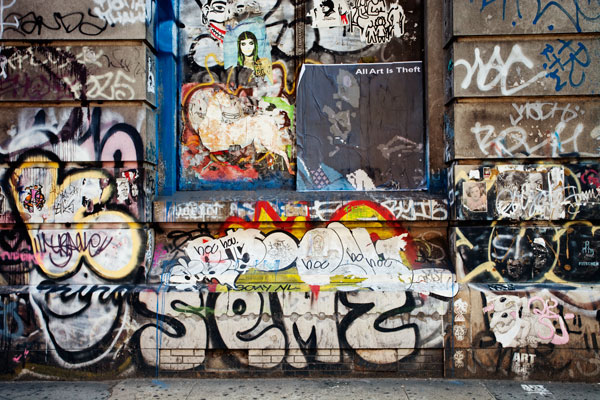
Appropriation artist targets Jay Maisel
Students for Free Culture, for bring this issue up
Jennifer Sanchez, 3L @ Seattle University Law, for legal research for this post.
Closing thought:
“A parodist need not demonstrate that the copyright owner would prohibit the use in order to qualify the copy as fair use under Campell.” Leibovitz v. Paramount Pictures, 137 F. 3d 109, 115, C.A.2 (N.Y.), 1998.
We need the same rights for remixer, even if they love the art they are remixing!
Edit: title changed to Jay Maisel: Copyright Misused as Censorship
]]>I heart the Happy Tree Friends, but this video is blatant propaganda. The threat level rhetoric is through the roof, while fair use is reduced to a short section read at micromachine speed that ends in get a lawyer…
No mention of free speech or the value of critical commentary. Even mash-ups and remixes are slammed. Who wrote this a room full of RIAA advocates that took the heart of youtube (remix and memes are the heart not some mythical unicorn called purely original content) and reduced that heart to a poorly written law review article footnote…
I would love to see a remix oft his video that takes the copyright trolls and warns them that sending takedowns without considering fair use may cause them to lose fans, with key phrases like the first amendment, free speech, censorship, everything is remix and building on the shoulders of giants.
Shared by Public Knowledge.
Hear is an idea: How about a remix challenge. I am willing to offer a free lunch to best remix of this video that incorporates the values of remix and free speech while educating people on there rights. Upload a remix and tag it with remixCopyrightSchool or post a link in the comments or email me [email protected] to be considered. I will judge the results on April 30th and post the winner May 1st. (If you are outside a city I am in this summer I will send you $ to buy lunch)
Update: the copyright school has a video that tries to explain fair use and it is terrible. Bad 70′s music. Lots of legal ease. The recommendations are use the public domain or write original content. Pardoy is mentioned once, but never explained. It reads like a lawschool text book with no concrete examples. I the video is design to confuse and encourage people to get a lawyer. It even tells people to go to the copyright office to find the rights holder then go buy insurance and permits. This is licensing not fair use.
The film is aimed at professional film makers and is useless for 99% of you tube users. (the only bright spot is they mention the American University’ Center for Social Media which has much better resources)
PS I was divided on what to offer as a prize as I do not want to make the challenge commercial and endanger your fair use claim.
]]>